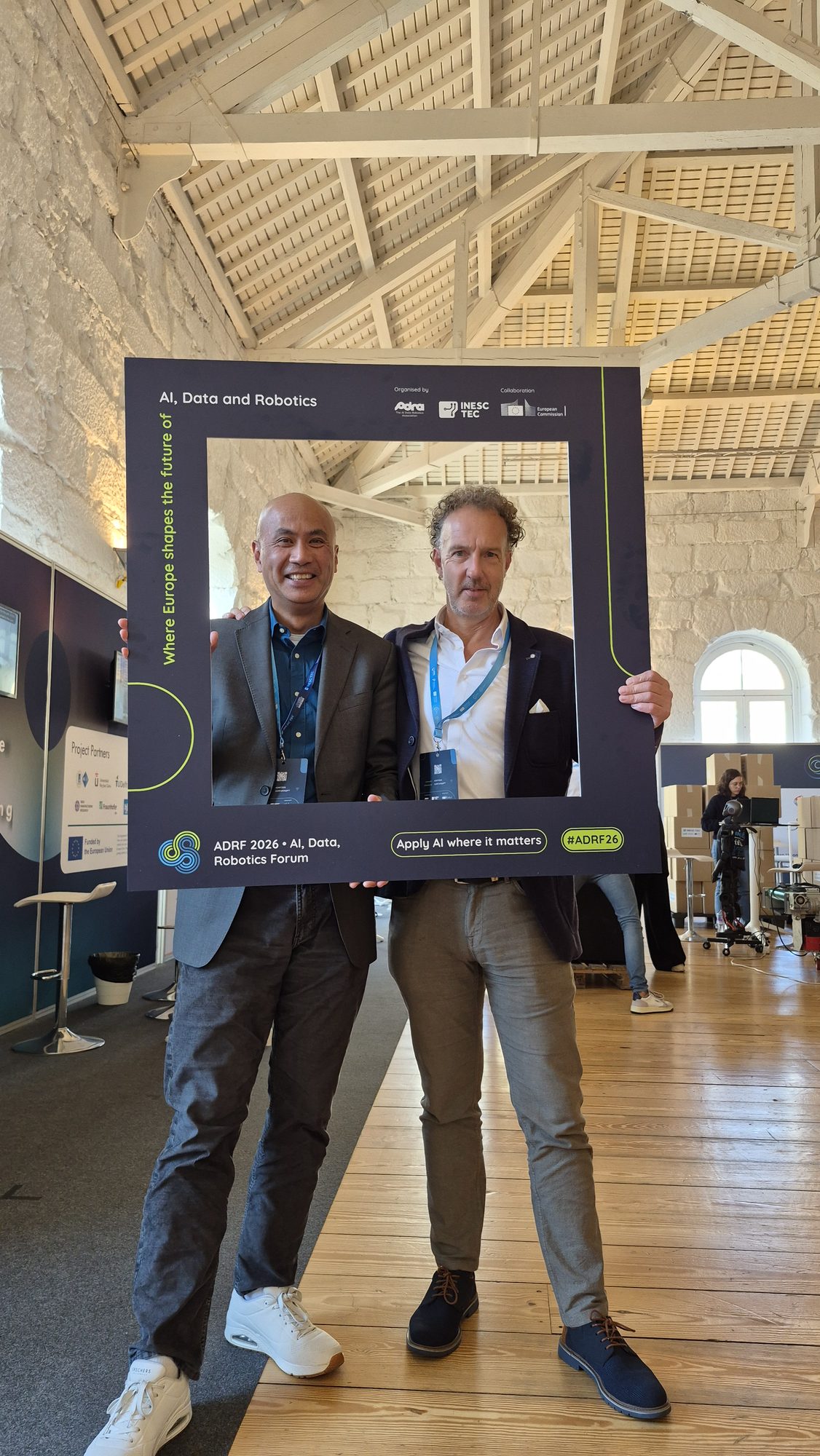

ADRF-2026: What We’re Taking Away from Porto
Europe doesn’t need to win the AI race. It needs to focus on where AI matters.
Where AI, data, and robotics converge in the physical world, new opportunities for autonomous systems arise. Program Director Alex Berhitu attended the AI, Data, and Robotics Forum in Porto on behalf of EDIH Northern Netherlands. In this blog, Alex shares what caught his attention there and what he’s bringing back for the Northern Netherlands.
Choosing Where AI Matters
The annual meeting of the European Association for AI, Data, and Robotics (ADRA) offered two full days of opportunities to share knowledge and experiences and make new connections.
The Northern Netherlands has big ambitions in the field of AI and autonomous systems. In Porto, I saw how AI and data in the physical world come together in robotics and evolve into autonomous systems.
Physical AI, Embodied AI, Situational AI: these are all terms for what we at EDIH NN have summarized as AI-Driven Autonomous Systems (AIDAS). I’m glad we made this choice at EDIH NN. This was nicely endorsed during the opening by Girardi, president of ADRA:
“The EU isn’t leading the AI race… and it doesn’t need to. We need to choose where AI matters… where it interacts with the real world… Physical AI.”
Safe Interaction in the Real World
The biggest question—or rather, concern—when introducing AI into the physical environment is trust. Whereas robots used to perform preprogrammed actions, AI is enabling them to devise and execute actions more and more independently. This also means that there is less certainty in advance about what a system will do in a given situation.
Safe interaction in the real world was therefore a key call to action in Porto. A large portion of EU-funded research focuses on safe interaction.
The next question is how to ensure that security. Opinions on this varied in Porto. There is a strong desire for standards and protocols. At the same time, at least an equal number of participants questioned this approach. In their view, innovation comes to a halt once standards are established, whereas innovation is precisely what we need.
Innovation must also drive economic growth
But innovation alone is not enough. The European challenge is also to translate excellent science and innovation into economic growth.
A better balance between “technology push ” and “user pull” can help achieve this. Currently, that balance still leans too heavily toward “technology push”—developing technology based on what is technically possible. With the Catalyst program, ADRA aims to place greater emphasis on “user pull.”
This may also be an interesting European grant program for the Northern Netherlands. It can help translate the use of autonomous systems into economic growth, both for the developers and for the users of autonomous systems.
Collaborating at the European Level
I look back on two days filled with valuable inspiration and new connections. Above all, it has shown me two things. We must also collaborate at the European level in the field of autonomous systems. And with the developments in the Northern Netherlands, we’re making a difference.