

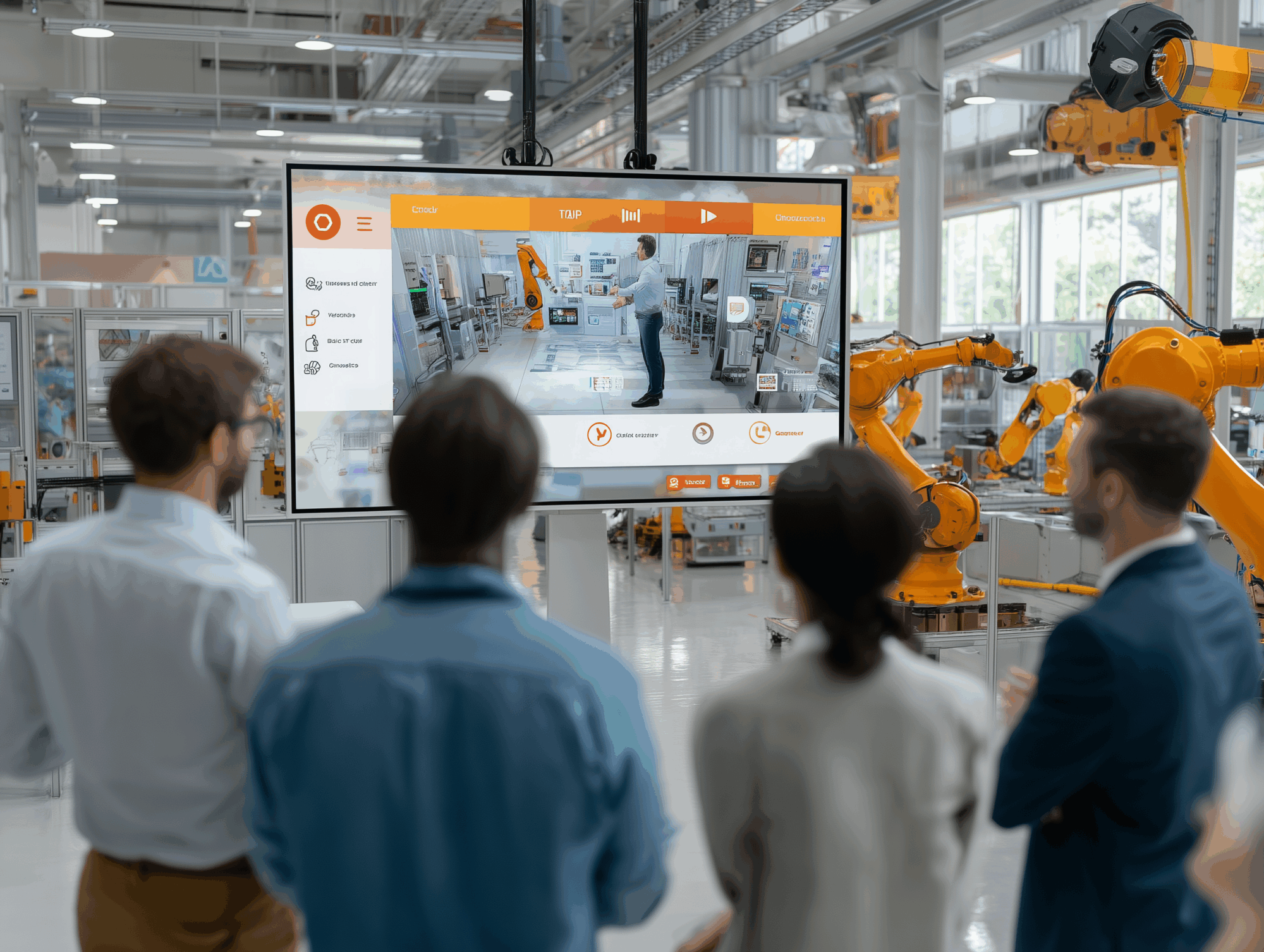

Preserving Knowledge: Why Digital Work Instructions Are Indispensable Today
By the editors of EDIH NN - Inspired by the questions of the shop floor, and the pace of technological change.
These days, it’s hard to find people, and they’re quick to leave. While automation and AI are shaping the future of industry, day-to-day operations on many factory floors remain a human endeavor.
In an era when supply chains are monitored in real time and predictive maintenance is commonplace, the transfer of work in many places remains stuck in a static PDF, a lengthy Word document, or a single email.
Smarter manufacturing calls for smarter instructions
The future of industry is autonomous. That means systems that make decisions independently, adapt to circumstances, and continuously learn from data. And yet, one constant remains in that future: people. Because whether you’re working with cobots, smart assembly lines, or digital twins, truly smart manufacturing only emerges when people and systems collaborate optimally.
This requires clear communication between people and machines—information that is accurate, up-to-date, and available exactly when needed. That’s exactly where Digital Work Instructions (DWI) make a difference.
Paper Instructions as a Hindrance to Progress
Many manufacturing companies still rely on paper instructions: static documents that are difficult to update, often outdated, and hard to track. In an environment that demands flexibility, speed, and error-free operations, these resources are simply no longer sufficient.
- What if that human knowledge disappears?
- What if the instructions don’t keep up with the pace of change?
- What if a new employee needs three weeks to understand something that could have been conveyed digitally in three minutes?
Digital work instructions replace that outdated approach with a smart, dynamic one. Via tablets, screens, or smart glasses, they provide context-dependent, interactive instructions that adapt to the work environment—whether that involves human actions or interaction with autonomous systems.
What exactly are digital work instructions?
Digital work instructions are real-time, interactive documents that guide employees and systems through their tasks:
- They facilitate the transfer of knowledge from experienced to new colleagues
- They help prevent errors through feedback and data logging
- They ensure the standardization of processes
- They offer version control and are easy to update
- They make it possible to safely transfer tasks between humans and machines
In short: they are a crucial link in the infrastructure of a future-proof factory.
The Strategic Value of Digital Work Instructions in Autonomous Ecosystems
In a context of increasing autonomy, instructions are no longer intended solely for people. Systems, too, can benefit from clearly structured, machine-readable instruction formats. Consider production environments where work instructions serve as input for cobots or where operators perform tasks together with AI assistants.
That is why digital work instructions (DWIs) serve as a bridge not only between people, but also between people and autonomous technology. And that is exactly what Smart Industry is focused on today.
From AI Hype to AI in Practice
The implementation of digital work instructions often raises questions: Who creates them? How much time does it take? Do you need to be an IT specialist to do it?
In practice, it turns out that AI can take over part of that work. Tools such as TNO’s Instant Instructions make it possible to automatically generate work instructions based on a simple video recording. Less manual work, more consistency, and immediately applicable on the job site.
During regional workshops organized by Smart Industry Nederland and EDIH NN, companies have the opportunity to experience this firsthand—not through theory, but through real-world use cases and practical tools.
Why this is relevant right now
- Companies that invest in digital work instructions benefit from:
- Shorter onboarding time for new employees
- Reduced Dependence on Scarce Knowledge Holders
- Higher Quality Through Less Variation in Execution
- Responding more quickly to product or process changes
- Greater integration between humans and (semi-)autonomous systems
- And all without months-long implementation processes or expensive custom software.
The Heart of the Matter
Anyone who thinks that digital work instructions are only for high-end factories or IT-intensive sectors is mistaken. It is precisely in small and medium-sized businesses, and particularly in the region, that there is the potential to make enormous strides with this technology.
Not just because it’s more efficient. But because it makes companies future-proof at a time when people and machines need to work together more intelligently.