

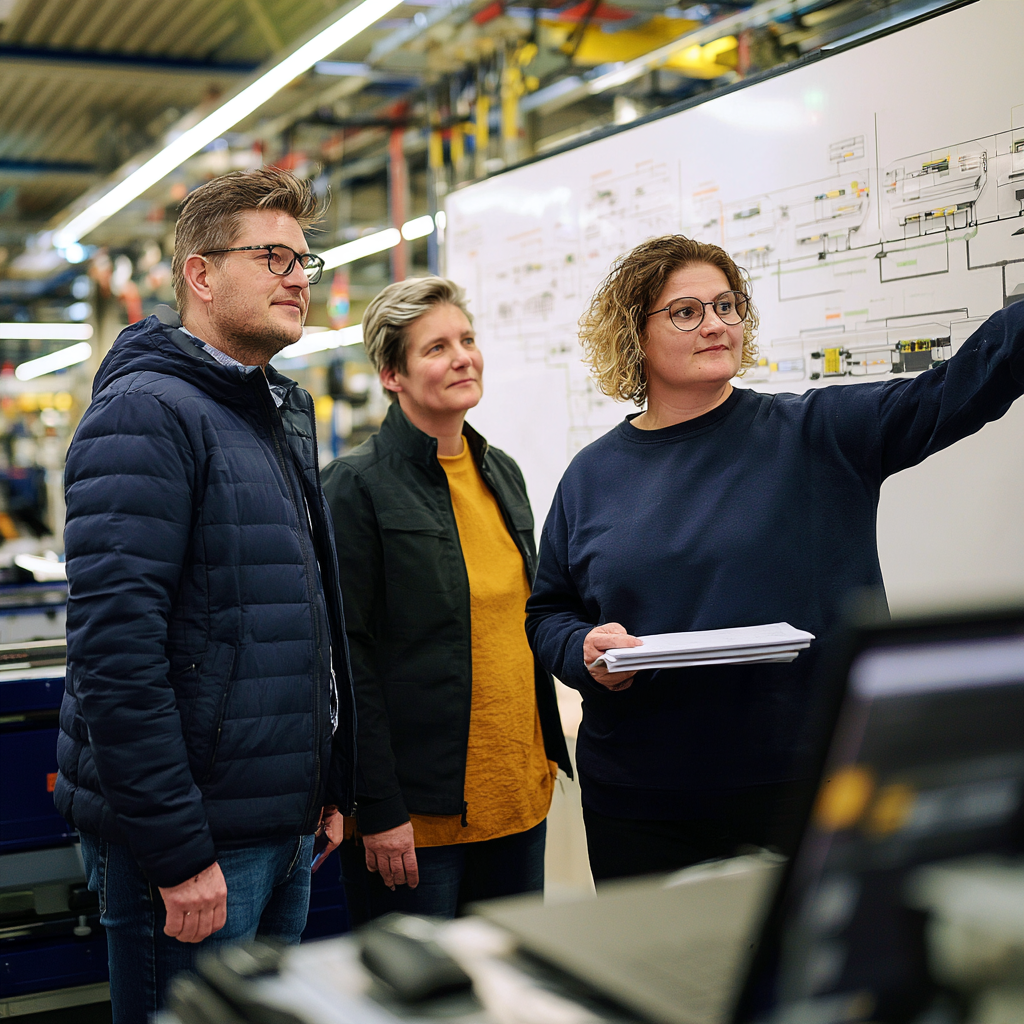

The most important AI skill for the coming years? Understanding your own work process
As AI tools become easier to use, the challenge shifts. It’s not the technology itself, but understanding and redesigning work processes that is becoming increasingly important. Those who know where decisions are made, where exceptions arise, where knowledge is lost, and where data is created can deploy AI in a much more targeted way. This means that process owners, engineers, and domain experts will play a key role in the next phase of AI adoption.
Not so long ago, writing a good prompt was a distinguishing skill. Those who knew exactly how to instruct a language model often achieved visibly better results than someone who simply typed in a question.
That gap is narrowing.
AI systems are getting better and better at understanding natural language. Software vendors are building AI directly into existing applications. Interfaces are becoming simpler, and more and more tasks can be performed without extensive technical knowledge.
That doesn’t mean AI is getting any easier. It mainly means that the scarce knowledge will be located elsewhere.
The question is becoming less common: How do I get AI to perform this task?
And increasingly: Which task do we actually want to improve, how is it currently carried out, and what needs to happen when AI takes over part of it?
A poor process won’t automatically improve with AI
Suppose a company wants to use AI to automatically process incoming customer inquiries.
Technically, more and more is possible in this area. An AI model can read an email, recognize the subject line, retrieve relevant information from other systems, draft a response, and determine which employee is most likely to handle the inquiry best.
But that doesn’t mean the process is solved yet.
After all, what happens when a request is incomplete? Which customer inquiries can be handled automatically, and which cannot? Who decides whether an exception is significant enough to escalate? Where can you find the knowledge needed to provide a good answer? And what happens to new information that arises during customer interactions?
Anyone who can’t answer these questions doesn’t have an AI problem in the first place. They have a process issue.
AI can automate a single step. But to make an entire workflow smarter, you need to understand how that workflow actually functions.
The most valuable insights are often found between the steps of a process
On paper, processes usually seem straightforward.
A request comes in, is assessed, processed, and completed. A product is designed, manufactured, inspected, and delivered. A malfunction is reported, investigated, and resolved.
In practice, it’s more complicated.
There are exceptions. Employees call a colleague because that person happens to know a lot about a specific machine. An engineer always double-checks certain designs. Information is copied from an email into an Excel file and then re-entered into another system. A production worker notices from minor deviations that something is about to go wrong, even though that knowledge isn’t formally documented anywhere.
That’s exactly where much of AI’s value can lie.
But only if organizations first make it clear what’s actually happening.
That’s why four questions are becoming increasingly important:
- Where are decisions made? What considerations does an employee weigh before the process continues?
- Where are the exceptions? When does the standard approach not work, and why?
- Where is knowledge hidden? What information is primarily stored in people’s heads, email inboxes, documents, or disparate systems?
- Where does data come from? What signals, measurements, and decisions can be used later to further improve the process?
These aren’t questions just for a data scientist or AI specialist. Rather, they call for people who have a deep understanding of the work, the product, or the customer.
As a result, this also changes who is key to AI adoption
When it comes to AI, people tend to look first to IT departments, software developers, and data specialists. Their expertise remains essential, of course. But successful implementation requires a broader combination of knowledge.
A maintenance engineer knows why the same error message can mean something slightly different for two different machines. An operator knows which product variants are more likely to result in ambiguous results during an automatic check. A nurse knows what information is crucial in a handoff. A work planner knows why a seemingly logical schedule is sometimes unworkable in practice.
That kind of domain knowledge ultimately determines whether an AI application is merely technically impressive or actually adds value.
This also changes the role of employees. The domain expert doesn’t have to build an AI model themselves. But they do need to be able to explain how the work is structured, where the bottlenecks are, and under what conditions a solution is viable.
For AI adoption, technical skills and process knowledge are therefore not mutually exclusive. They reinforce each other.
From a standalone AI tool to a redesigned process
That difference is evident, for example, in the manufacturing industry.
A company can use computer vision to automatically check whether a product has a defect. The technology can analyze the image and flag a potential defect.
But that’s when the important questions really begin.
When is a product actually rejected? What happens when the AI system is uncertain? Is only the product in question inspected, or is the rest of the batch inspected as well? Can the deviation be traced back to a machine setting earlier in the production process? And can information from previous deviations be used to prevent new problems?
The greatest benefit doesn’t come from automating a single visual inspection. It comes from better integrating quality control, production data, human expertise, and decision-making.
The same principle applies to generative AI.
Helping an employee save five minutes when writing a report can be useful. It becomes more interesting when an organization investigates why that report is being written, what information is collected each time, who needs that information, and what follow-up decisions depend on it.
It’s no longer about automating text production, but about redesigning information flows.
So don’t start with the tool
For organizations looking to get started with AI, it’s very tempting to begin by exploring the possibilities of a new application.
What can we do with an AI assistant? Can we build a chatbot for this? Can we automate this?
Another opening question often yields better results:
Which process do we want to improve?
Then you can investigate where time is being wasted, where errors occur, what knowledge is difficult to access, which decisions require a lot of manual work, and what information is already available.
Only then does technology come into play.
Perhaps AI really is the answer. Perhaps better data is needed first. Perhaps a process needs to be standardized before automation makes sense. And sometimes, a relatively simple digital solution proves to be more effective than a sophisticated AI model.
That’s not a step back in terms of ambition. It’s exactly what’s needed to apply technology in a targeted way.
AI doesn’t make domain knowledge any less important—it makes it more valuable
The next phase of AI will therefore likely not revolve solely around people who know how AI works. Just as important are people who understand exactly where AI can make improvements.
This requires collaboration between technology experts and people with hands-on experience—between data and operations—and between software developers, engineers, process owners, and employees who work with a process on a daily basis.
For small and medium-sized businesses, this is an important insight. Not every company needs to build its own large AI team. However, it helps immensely when an organization can clearly define its own needs: where does the process get stuck, what knowledge is needed, what data is available, and what specifically needs to be improved?
From there, you can conduct a targeted search for expertise, training, an experiment, a technology partner, or a test environment. This aligns with the broader role that EDIH NN aims to fulfill for the Northern Netherlands: helping companies translate a digital or AI challenge into a concrete path toward learning, testing, financing, and implementation.
Technology is changing rapidly. But that’s precisely why a very human skill is becoming more valuable: truly understanding how the work actually gets done.
Perhaps that will become one of the most important AI skills in the coming years.